The home to the wandering cat..
Showing posts with label katze. Show all posts

Saturday, 22 March 2014

The lynx

The Lynx... is IT!


The Lynx derives from the indo-european word leuk, meaning 'light brightness' in reference to their reflective eyes that appear luminescent...


They are known for their short tails, pointed ears and hair under the chin that resembles a bow tie. They grow to 28 inches to the shoulder and up to 51 inches long. The adapt rapidly, if a Lynx moves to a colder, snowy environment, its hair will grow lighter, for camouflage. It's paws will grow and spread out and can get bigger than a human foot, to deal with the snow.


The Eurasian lynx


The biggest of the four lynx species. Native to Europe and Siberian forest, it ranges all the way from Russia to central Asia. It only eats meat being carnivorous and needs to eat 1-2kg a day. It favors Roe deer but is an opportunistic hunter and will eat any prey.
Their coat has a brief period of reddish brown which is replaced by a much thicker grey-brown coat at winter.
It is the third largest carnivore in Europe after the brown bear and the grey wolf.

The Canada Lynx


The Canada lynx as the name suggest can be found in Canada and some parts of Alaska.


Its a good climber and swimmer. it makes its shelter out of rock ledges and broken trees. It has large paws that allow it to spread its weight ion the snow, twice as effective as the bob cat.
97% of the lynx's diet is made up of snowshoe hairs, although will hunter other small prey if it has to.


Iberian lynx

sources for images contact for usage rights

http://www.acacciaperilmondo.it/it/p_caccia-grossa-in-russia.htm

http://macnews.tistory.com/536

http://commons.wikimedia.org/wiki/File:Montana_lynx_fur_jacket,_Slupinski_D%C3%BCsseldorf_2011_(1).jpg

Friday, 19 April 2013

Cat's In Space?! - Cats in the hall of fame

Many animals have been sent in man's plight to touch the moon. It is common knowledge monkeys made safe journeys around the earths orbit and lived to tell the tale, like Able.

Able on exhibit
Able was the first monkey who successfully returned from orbit back in 1959. He lived for another 26 years before dying 26 years later due to a reaction to anesthesia, whilst undergoing surgery to remove an infected medical electrode. He is now an exhibit at the National Air and space museum, USA.

Unfortunately not all animals made it safely back. People had no idea on the effect of being in space orbit would have on biological organisms. Many animals died from suffocation, overheating or drowning at sea on impact. However to minimize stress animals would anesthetized before lift off and were only sent into space once. It was all to test whether humans could survive long periods of weightlessness, scientists had been debating for years whether it was possible. It certainly taught the rocket scientists a lot about space. I will leave you to decide whether you think it was worth saving human lives or not.

Many different animals were sent to test the different effects.

Monkeys of several species were used; The rhesus monkey, cynomolgus monkeys, squirrel monkeys, pig-tailed monkeys and even some chimpanzees.
Mice, bees, frogs, worms, turtles, stick insects and other insects.
Fruit flies were the very first animal ever sent, they made it home safe.
Rabbits and rats. lots made it home, lots of them did not.
After monkeys they tried dogs as they thought these would be calmer during space flight. Many of the dogs are unsung heroes. JFK was given a space dogs puppy, as a gift for his grandchildren.

Several cats were trained, 10 decommissioned as they ate too much!

But I know you're here to hear about if kitties were able to become space-cats. The answer is yes. Felix and Felicette are two well know cats from the space program in France.

A not so glamorous shot of astr-cat Felicette

Felix was a stray, black and white cat,taken from the streets of Paris. He went trough training but not long before the flight he was reported to have escaped.
So instead Felicette was quickly trained and sent up instead in 1963. It was a short flight lasting 15 minutes but she travelled 100 miles into space which is when she was released in a capsule with a a parachute.
The flight was a success and she was recovered in good health. what became of her is unsure but British papers called her "astro-cat" and stamps were released all over the world but because of felix's last minute ditch they all had his name and face on them.


"Felicette on recovery"
I tip my hat to Felicette the female feline who risked her life in the name of science, robbed of the face of stamps and nearly forgotten.
stamps showing Felix instead of Felicette


Since then other cats have attempted space one weightless experiment was uploaded to youtube. i think the experiment is to see if the cats would know they are floating or to see if they would still try to flip over.


some other videos i found, some more questionable than others.


http://en.wikipedia.org/wiki/Animals_in_space
http://history.nasa.gov/animals.html
http://www.purr-n-fur.org.uk/famous/felix.html

Wednesday, 6 March 2013

What's really happening with Snow Leopards...


So we have all seen the adverts on the Tv asking for donations to help save Snow Leopards. I soon realized i know less about these kitties than any other, i wanted to know why their numbers are struggling and what the real future prospects are for this beautiful breed. 


So first i ask for numbers. Most estimates are acknowledged to be rough and out-dated so it is hard to guess but the latest numbers are  4,080–6,590. Now this doesn't sound too bad but the actual amount that are able to reproduce is only 2,500 (50% of the wild population).


As expected, as the population of humans increases, it takes it's toll on all species we live alongside.The Snow leopard is increasingly losing habitat and numbers of wild prey are down too. But don't worry there is help on the horizon. There are many organisations out there such as the snow Leopard Trust, the snow leopard conservancy and the snow leopard network. these and many other non-profit donor organisations which are helping to make a feature for these beautiful cats.


The darker side of the tale is the fact people are hunting these animals for our own selfish reasons. Their fur is sold for rugs, clothing and taxidermy. whilst their bones are ground and used in medicines. Teeth for jewelry and decoration. 

Although it is rarely talked about it is happening. recently it was noted tribes in rural Asia are bribed with resources and alcohol and given guns to catch wildlife. this makes a huge impact when they are now killing more than is needed to sustain there villages, impacting the ecosystem greatly.


Kazahkstan  is the only country that has any recent reports of snow leopard bones being trafficked but even the figure is probably wrong.  in Kazahkstan it is reported that 8-10 are poached annually with no arrests or seizures having ever been made. 

it is obvious that some countries are not concerned enough. between 1994-1995 newspaper ads can be found selling their furs. Sales to the United States fetched $25,000 per animal. this isn't the only nation at blame. in fact, trafficking records are like this for all Snow Leopard bearing countries.


But it isn't just killing Snow leopards where the money is, many live specimens are kept to be sold as pets. These animals then go on to secret lives. Even though it is illegal to do so these animals are generally in high demand because of their high mortality rate and low life expectancy in zoo's. it is reported between 1960-1980 many illegally trapped snow leopards were sold to zoo's.

---------------------------------------------------------------------------------------------------
Snow leopards are native to Central Asia, it generally hangs out in Alpine and Sub-Alpine areas meaning high above sea level normally in mountainous regions, hence snow being in his name. In summer they will live above the tree line then when winter comes they will go below it to maintain as constant temperature as possible.


One of their main attributes is their beautiful coat. its undercoat is a grey-yellowish colour  and they have rosettes of brown along their body head and tail. Most notably in snow leopards is their eyes, a pale green-grey and sometimes blue.


Snow leopards are one of the smaller big cats weighing between 22kg and 55kg. Occasionally a large male is recorded to reaching 75kg. they may be small in size but have one of the longest tails reaching 80-100cm. 


the snow leopard has adapted to its environment by developing unusually large nasal cavities that help it breath arm warm the cold air. 


They live a reasonable solitary life although some females will stay with her cubs in dens for extended periods. like other cats they scent their territory although this could be harder in snow, so they generally spray on sheltered patches of rock.

It depends on the time of year and whats available on what they hunt. their main prey is considered to be the Himalayan blue sheep and other sheep breeds. Other types include wild goats, deer, rodents, langur monkeys and birds such as the snow cock.

 The snow leapord can not roar! notably down to having no larynx but it can still make mews, wailing, chuffing, growling and hissing.


An adorable video of a gorgeous snow leopard cub.


sources:


 all images taken from the wikipedia website:
 http://en.wikipedia.org/wiki/Snow_leopard

charitable organisiations and sites of interest:

the snow leopard trust
http://www.snowleopard.org/

the snow leopard conservancy
http://snowleopardconservancy.org/text/help/help.htm?gclid=CN2zke6W6bUCFRDKtAodwHcAQg


Saturday, 2 February 2013

How to train your cat to walk on a lead


Wondering how on earth are you going to get that cat on a lead? Here are some top tips on how get that kitty into it.


Firstly get your cat used to a harness, I was trained as a kitten when i was too young to go out by myself. This the best time to start but cat's are smart and most cats can be trained at any age.

When choosing a harness choose one with clips, instead of buckles,  it's a lot quicker to put on so less stressful at the beginning.

I have tried a few different brand and styles of collars. The best are the ones that do not go round the throat. Also i find the cushioned harnesses are better as i like to pull, alot.

NEVER- ever ever, put a lead on your cats collar. It will choke him and make him hate the lead and you for doing it.

With leads, the longer the better and extendable dog leads work well. When you start training your cat will follow you and run in spurts, if the lead is too short you will also have to run with the cat, which will make them freeze, turn around and stare and you with big please don't eat me eyes.

So you're back from the shops with all the goodies for the cat?
First time round let him smell the harness but don't make it the main focus, get the treats ready and as they are scoffing a couple try and put the harness on as quick as you can. If they try to stop you, just restrain until it's on and tightened ect.
 ( If your struggling and your just running around the house after him stressing him out, just stop and try again later. You don't want them thinking harness = bad things)
Reward with treats and your cat probably wont even notice the harness is on.


 Clip the lead on, pick the cat up and start walking around your garden. This is best done outside, along their normal patrol paths if they are already outside cats. Make sure its a quiet area, every time he gets spooked they will just want to freeze and hide. keep walking with the cat in your arms till he demands to be put down.  Start walking in the direction you want to go and he probably wont follow you or start to walk off in their own direction of interest or try and hide in a bush. pick the cat up and carry on walking till he demands to be put down then start walking in the way you want to go. This may take you 10 attempts it may take a 100 recreating the process over several months, i'm nearly a year old now so been doing this for 9 months and still improving . Eventually the idea is if he doesn't want to be carried he has to walk the way you want to go.


 Please respect that cat's don't like walking through the middle of a field. so instead stick to the going around the edges of the fields, gardens, until you get there.


This is not an overnight process. Do NOT drag your cat around trying to encourage them, we are much slighter than dog's and cant handle being yanked about.

 Understand the weather can be too hot or too wet to go walking in. Build up your cats stamina as it will be very tiring at first, take regular breaks to catch their breath. always carry around a bowl and water, treats are good too.

 Just because your cat follows you around the block doesn't mean you don't need to put a leash on them when anywhere unfamiliar. it could easily be scared by a dog/person/car/anything. This will cause them to seek a hiding place making them run off. Then try to imagine how long that might take to find them in the middle of the wildernes...

What my owner does if something is approaching us that i don't like, for example a dog, she will jsut pick me up untill we are past it. I feel safer high up and it stops me getting so stressed about having to cross paths with it.

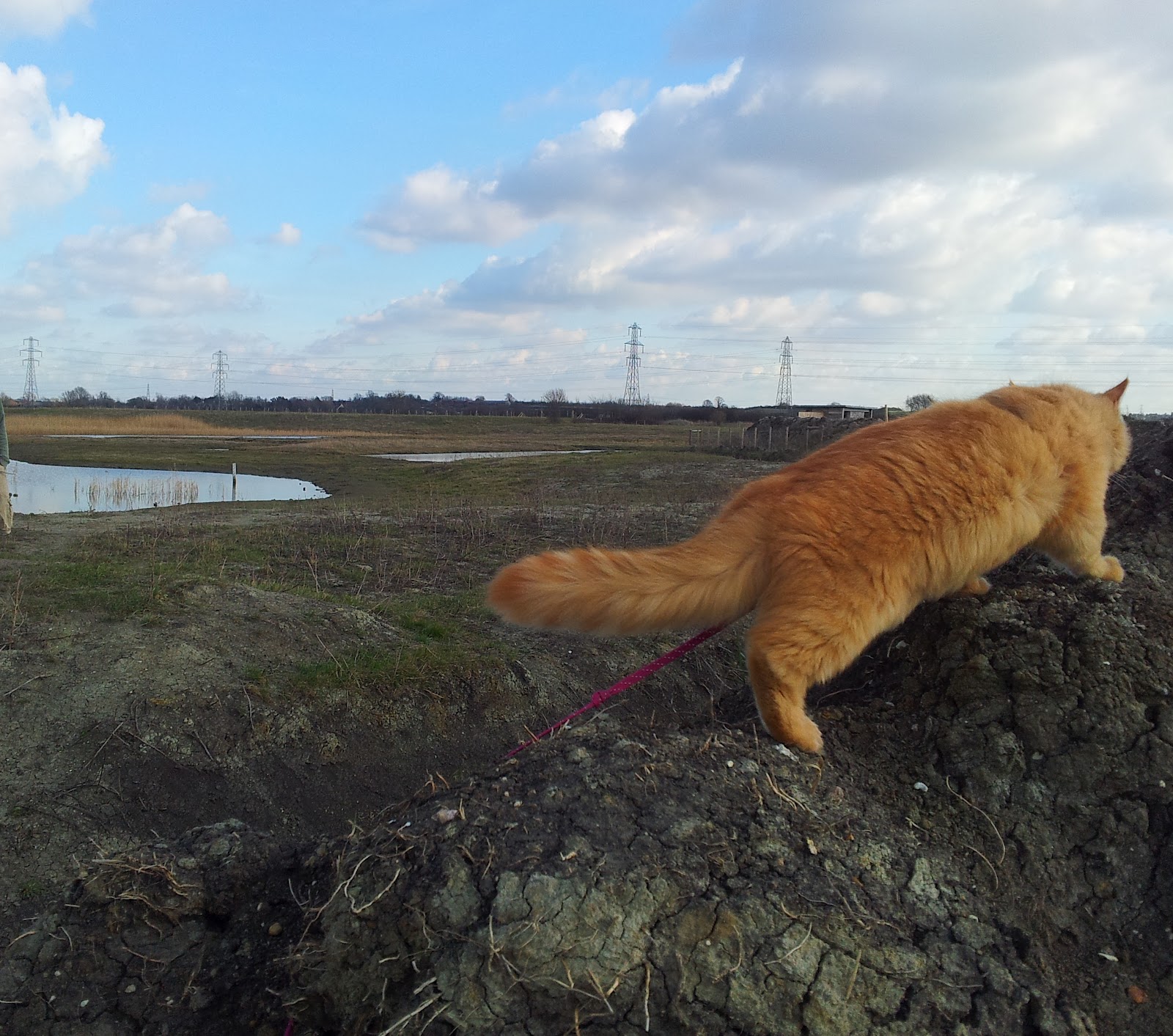
Once you have mastered the leash and harness you can take your kitty everywhere! This has great rewards for both you and them. Cats love patrolling new territory and bonding time with you. It also means your kitty doesn't need to stuck indoors all the time. I have had many great adventures with my humans. Seeing things i never thought i would; like waterfalls, meadows, mountains and caves.


 So what are you waiting for?

Saturday, 26 January 2013

cats in the hall of fame

Hey guys going to start doing this regularly to honour those kitties that make this world a little cuter.


Today i gice you "Casper the commuting cat" a cute little cat from plymouth who was crazy for bus rides! He was adopted by his human who had no idea of his habits! Eventually the bus drivers found out he was sneaking on without a ticket but they continued to give him free rides for the rest of his life. Ofcourse casper became a local celebrity and a lot of humans got to enjoy his company. Unfortunatley Casper passed away at the age of 12 but his memory lives on on the busways of plymouth. 


Monday, 18 June 2012

The Scottish Wildcat numbers are down to 400!!


We have to take a moment for the largest wild mammal in Britain, before it's too late. 


The Scottish cat numbers have dwindled down to 400 and that's including the ones in captivity!! They were here before human kind and long before our domesticated cat had evolved. But soon our last large mammal predator will just be a statistic among the British Wolf and British Lynx.


One of the biggest problems is that our feral/domesticated cats are breeding with the Scottish Wildcat and diluting the species into extinction. So much so, that some specialists studying them have had as little as only 3 sightings of these cats in the 25 years of their career. They are extremely suspicious of humans it can be impossible to track clans and even more so the lone population of the cat's.


Infamous for being unable to be tamed a true wild cat. Once roaming over all of Britain's pastures they have been chased to the far corners of Scotland. Larger than the domesticated cat it hunts deer and Lamb. Of course there are old folk tales of them killing human beings. Dogs are the most common casualties. Many believe the fen tiger sightings in England are really the wildcat or the 'Kellas' its descendant which is jet black.


They eat nothing but meat and most of their water intake comes from meat too. In-fact if cats are fed a vegetarian diet they would go blind, so a killer instinct is rife. Ferocious, cats have been seen killing themselves to kill an eagle attacking their cubs nest. Their teeth are so sharp they are known to bite clean through a gauntlet or hand. If approached they hiss and their hackles raise but instead of trying to look big like our house cat's they mock charge, exactly what a big cat like a lion or tiger would do.


The wildcats brain has a third lobe at the front of the brain that acts as a spirit level. This is far more advance than the human's brain in this respect but probably comes in handy when you are trying to catch flying objects in the air.


Fortunately it seems there are some out there trying to save the small population left. Huge efforts are being made this year to try and get a better idea of how many are still true wildcats and how we can encourage their numbers. We need to act fast before they are forgotten forever!


 pictures sourced from the Wikipedia website